Showing posts with label BMW. Show all posts

Friday, January 13, 2012

BMW Adds 125i 125d and 116d


The new 1-Series five-door hatchback is the next BMW after the 3-Series to benefit from the addition of a fresh batch of engines. The new models presented in Europe are the diesel-powered 125d and 116d EfficientDynamics Edition, and the gasoline-powered 125i.

Beginning with the latter, the 125i gets a new 2.0-litre four-cylinder gasoline with a twin-scroll turbocharger and direct injection delivering 218bhp at 5,000 rpm and peak torque of 310Nm (228 lb-ft) between 1,350 and 4,800 rpm. With a six-speed manual, the 125i sprints to 100km/h (62mph) in 6.4 seconds (8-speed automatic transmission: 6.5 seconds), reaching a top speed of 245 km/h or 152mph (243 km/h).

BMW says the 125i has an average fuel consumption of 6.6 lt/100km (35.7mpg US or 42.8mpg UK) with CO2 emissions of 154 g/km.

Next up is the 125d powered by a 2.0-liter turbocharged four-cylinder diesel producing 218 bhp at 4,400rpm and 450Nm (331.9 lb-ft) of peak torque. Both with 6-speed manual gearbox and with 8-speed automatic transmission, the compact five-door model goes from zero to 100 km/h in 6.5 seconds en route to a top speed of 240 km/h (149mph).

It achieves an average fuel consumption 4.9lt/100km (48mpg US or 57.7mpg UK) with CO2 emissions at 129 grams per kilometre. The automatic version has an average fuel consumption of just 4.8lt/100km (49mpg US or 58.9mpg UK) with CO2 emissions at a level of 126 g/km.

The third and final new addition to the 1-Series hatchback's range is the 116d EfficientDynamics Edition powered by 1.6-litre 4-cylinder diesel engine that delivers 116bhp at 4,000rpm and 260Nm (191.8 lb-ft) between 1,750 and 2,500 rpm. This model features additional measures to reduce fuel consumption such as low rolling resistance tires and aerodynamic upgrades.

Equipped with a 6-speed manual transmission, it accelerates in 10.5 seconds from zero to 100 km/h, with a top speed of 195 km/h (121mph). Its average fuel consumption stands at 3.8 lt/100km (61.9mpg US or 74.4mpg UK), with CO2 emissions of 99 g/km.

In Europe, BMW will soon launch the M Sports Package for the new five-door model that includes a host of aero components plus a 10mm lower sports suspension, 17- or 18-inch M Style alloys and numerous interior trim upgrades.
PHOTO GALLERY

Friday, December 30, 2011

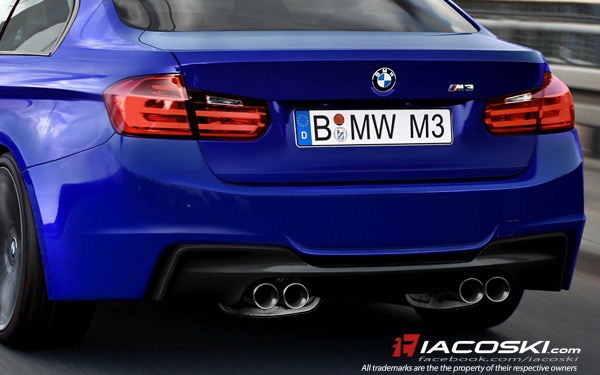
2014 BMW M4 / M3 Coupe Realistically Rendered


Its name and the type of engine that will lie under its hood may be debatable, but plans for a successor to today's M3 Coupe do exist. However, you'll have to wait at least until 2013 to see the high performance model in BMW's dealerships.

For those of you that just can't wait to get a peek at the next M3 Coupe or perhaps as we may come to know it, the M4, graphic designer Jacek Kolodziejczyk has put his skills to work developing a pretty realistic rendering of the coupe model.

The 30-year old artist used several styling elements found on the new F30 3-Series sedan while also borrowing some cues from the M3 sedan prototypes scooped over the past few months.

While BMW is keeping its cards tight against its chest for the time being, it is believed that both the next M3 Coupe and Sedan models will replace the current M3's naturally aspirated 4.0-liter V8 with a smaller displacement six-cylinder engine employing two or maybe even three turbochargers for 450-horsepower or more.

Photo Credits: Iacoski via GTSpirit

 
PHOTO GALLERY

2014-BMW-M4-12014-BMW-M4-22014-BMW-M4-32014-BMW-M4-42014-BMW-M4-52014-BMW-M4-62014-BMW-M4-72014-BMW-M4-82014-BMW-M4-9

Saturday, December 24, 2011

BMW M5's Project Leader Says V8 has Few Things in Common with X5M and X6M Engine


Like its predecessors, the new 2013 BMW M5, which received its public debut at the 64th Frankfurt Motor Show, is based on the regular 5-Series sedan with some subtle exterior modifications but a whole lot of changes under the skin.

Now, some may think that BMW's M Gmbh performance division simply took a 5-Series sedan, beefed it up a bit and shoehorned the twin-turbo V8 found in the X5 M and X6 M SUVs under it's hood. However, Maximillian Ahme, the man that led the M5's development team, says that's not the case.

In an interview with the BMW M magazine, Ahme shed some light on the development and the unique features of the latest M5 super saloon.

Asked about when work began on the F10 M5, Ahme said: "Two to three years must be allowed for testing the development of a BMW M. In some cases, predecessor vehicles are used in the first phase, enabling initial engine tests to be carried out, for example. However, this is just a short phase. The fine tuning then involves the latest models."

Ahme added that approximately 2 million kilometers (1.24 million miles) were covered during the development phases of the new M5.

What about that engine? Ahme dismisses the notion that the M Division simply used the same engine found in the X5/X6 M models:

“The engine of the BMW M5 has been almost completely redesigned. In essence, the only feature it has in common with the engine of the X5/6 M is the bank angle (90 degrees) and the cylinder spacing. The specification sheet also indicated a higher maximum rotational speed of 7,200 rpm."

Ahme explains that a lot of features were added or changed including the larger charge-air coolers, an optimized Valvetronic valve timing, a new cylinder head and a wet sump with an additional oil pump.

The M5 also uses a double-clutch transmission instead of the conventional torque-converter automatic found in the X5 M and X6 M SUVs.

As far as the chassis is concerned, Ahme says that the front axle was reinforced and has a more rigid connection to the bodywork, while the tracks were widened and the rear multi-link suspension doesn't have any rubber bearings for a more direct feel.

With standard tires, maximum lateral acceleration can reach up to 1.2 g, though Ahme stresses that, depending on the surface, the M5 can achieve 1.3 g or "perhaps even a little more on the Nürburgring circuit".

Ahme previously suggested that all-wheel drive might become an option for the M5, as it would be the only way to harness additional power.

"In view of the performance and torque of the BMW M5, this might be considered an option. However, we believe any advantage is outweighed by the disadvantages of the all-wheel drive. More weight due to four driven wheels means higher fuel consumption and a shift in the axial load in the direction of the front axle," said Ahme.

"However, we are particularly concerned with a balanced distribution of weight for the driving performance typical of the M. We also had to position the engine higher, which would have led to a higher centre of gravity," he added.
PHOTO GALLERY


VIDEOS


Hyundai America Nabs BMW Designer Christopher Chapman


If there's one thing that Hyundai and Kia can lay claim to, is that both companies eventually understood the importance of design and made significant efforts to improve the styling of their vehicles in the past few years.

To achieve their goal, the Koreans didn't hesitate to bring in experienced designers from other brands, with the most notable transfer being that of Peter Schreyer from Audi who took over and revolutionized Kia's design language.

The South Korean group continues to inject its brands with foreign designers, with its latest hire being Christopher Chapman of former BMW fame. Chapman was named chief designer of the Hyundai Design Center in Irvine, California, and will be responsible for new vehicle and concept design for Hyundai.

“With over 22 years of experience in the industry working on esteemed automotive brands, Chris provides a level of talent that will help further our design portfolio,” said SukGeun Oh, Head of Design, Senior Executive Vice President Hyundai Design Center. “We are thrilled to have Christopher Chapman as chief designer for Hyundai and look forward to continuing the strong momentum of our vehicle designs.”

Chapman started his career at the Isuzu Technical Center of America in Cerritos, California, in 1989 and was the designer chosen for the exterior of the XU-1 show car, which won Best Concept at the 1993 Tokyo Motor Show.

In 1994, he joined the BMW Group at DesignworksUSA in California, where he designed the exteriors of the X5 Sport Activity Vehicle and X Coupe concept car before he moved to Germany to design the CS1 concept shown at the Geneva Auto Salon in 2002, followed by the first generation 1 Series production Coupe and its derivatives.

In 2002, Chapman was appointed Director of Automotive Design and has been responsible for leading several conceptual and production vehicles including the new X5, X3, Z4 and the first BMW 1-series E87.

“Christopher Chapman is an outstanding addition to the design team at HATCI,” said John Krafcik, president and CEO of Hyundai Motor America. “We are proud to add such a talented individual to lead the team of dedicated designers at HATCI that will continue to develop innovative vehicles for both the United States and global auto markets.”
PHOTO GALLERY

Twitter Delicious Facebook Digg Stumbleupon Favorites More